Thursday, May 28, 2009

Tsukimi necklace

I made this necklace this week, by Sunday or Monday. I called it "Tsukimi", which, in Japanese, means "viewing the Moon". It uses bluish-gray colours and seems a bit different from my previous work, since I use no focal beads or pendants. Still symmetrical though, but a continuous line of several Swarovski elements, gemstones and glass beads (that I brought from Prague).

It is a "lunar" piece, due to the choice of cool hues that reminded me of the surface of the Moon, thus, its name "Tsukimi".
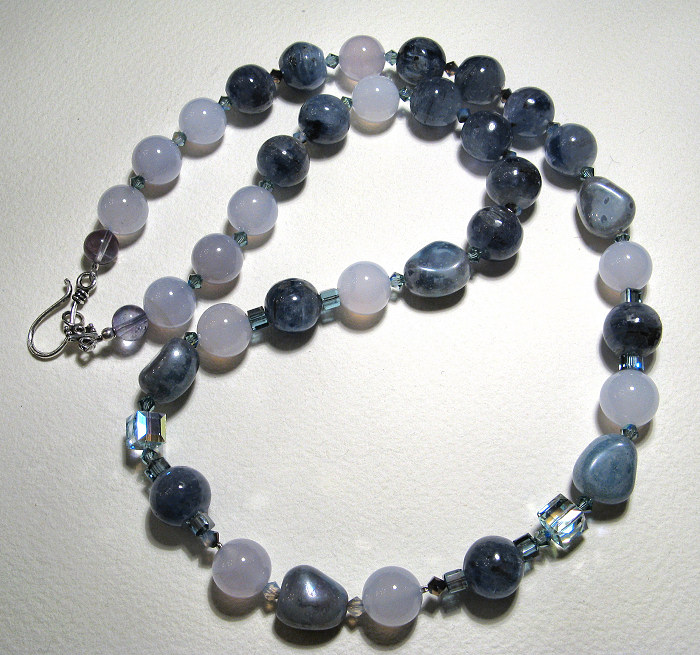

For this piece I have used:

- Tibetan silver hook clasp;
- Several kyanite round gemstones;
- Several chalcedony round beads;
- Swarovski elements in different shades of blue: cubes and bicones of different sizes;
- Several Czech glass glazed beads in bluish-gray;
- Two small fluorite beads near the clasp.

Some details of the above components to follow...
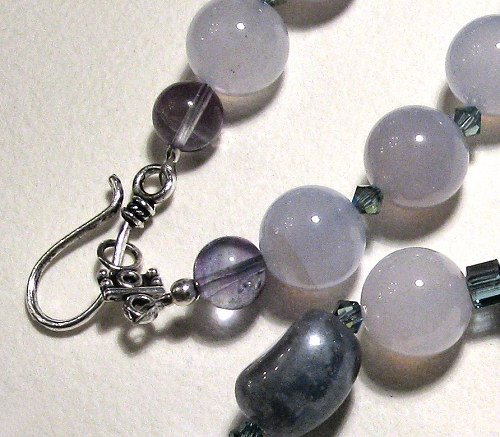

The 1st picture shows a detail of the silver clasp, the two small fluorites I used close to it, the lovely light blue milky chalcedony stones, along with some Swarovski bicones and a Czech glass bead. Second shot shows the Czech beads in detail, as well as two sizes of Swarovski cubes interspersed with some small bicones. Finally, the 3rd picture shows the string of beads: kyanites, chalcedonies, Czech glass beads and Swarovski elements, quite a simple structure. The necklace itself, since it is composed of mostly minerals, is quite heavy and I had to use a sturdier and thicker Beadalon wire, which, due to its gauge, is not quite easy to work with (the beads seem to "slip" though them a bit too easily, and crimping is very hard since the surface is so smooth and slippery). I much prefer the lighter, thinner wires due to their flexibility and slightly rougher texture.
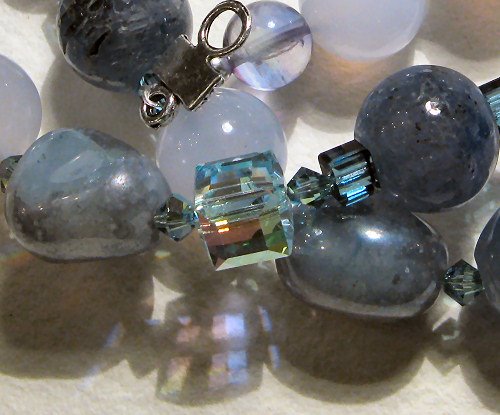
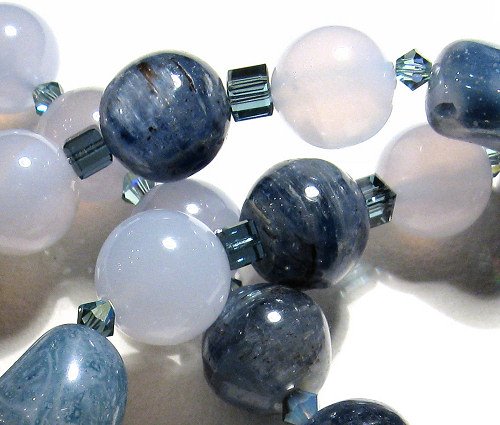
Another detail of the gemstones, Czech beads and lovely Swarovski elements with an AB coating. Chalcedony is the stone with the light blue tint and milky texture. Kyanite is the dark blue one, a sapphire-like shade of blue almost, very vitreous and speckled with silver/metallic streaks.
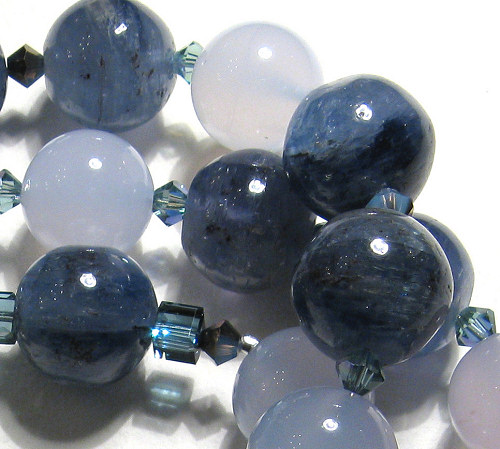
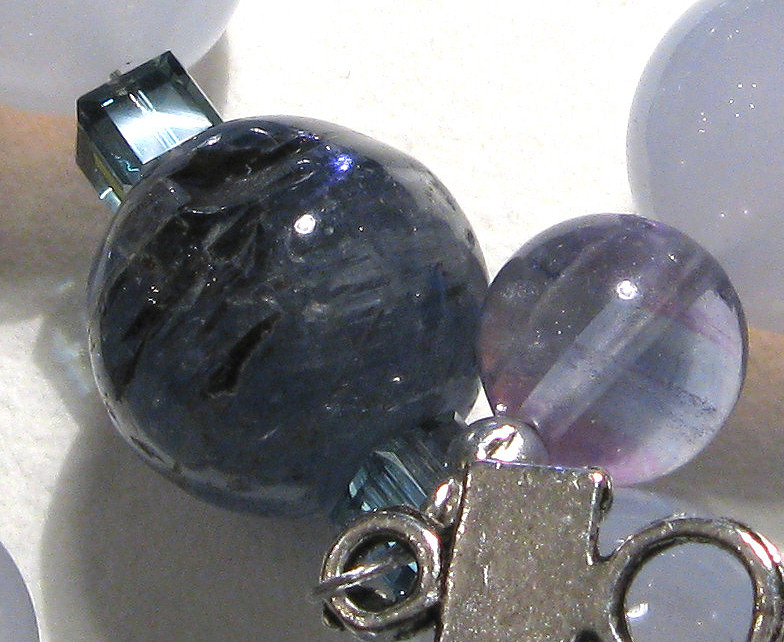
Kyanites and chalcedonies in detail once again, and a nice close-up of one kyanite bead, a small fluorite with its pale green and purple streaks, and one of the small Swarovski cubes.


I love the AB effect on the aquamarine coloured cubes (larger ones). The kyanites are also splendid, but unfortunately I have ran out of them!

Some more views of Tsukimi:

Saturday, May 23, 2009

Lovely Prague - Part 1...

We arrived from Prague last week. We went there for 5 days, since Mark ran the Prague Marathon for the 1st time.

It easily became one of my favourite cities. I love its cleanliness, the way everything works, and how calm the traffic is. People seem relaxed there. The shops (at least in the old town) stay open until late, and you can get some really nice ice cream and lovely drinks and food.

Also, that mix of Baroque, Gothic and Art Nouveau is absolutely enchanting, and very very unique.

My favourite walks must be the ones we took in the Josefov, the Jewish quarter area. Absolutely magical.

But tonight, I just want to post some curious pictures we took in several different places... Please click on the thumbnails to magnify them.

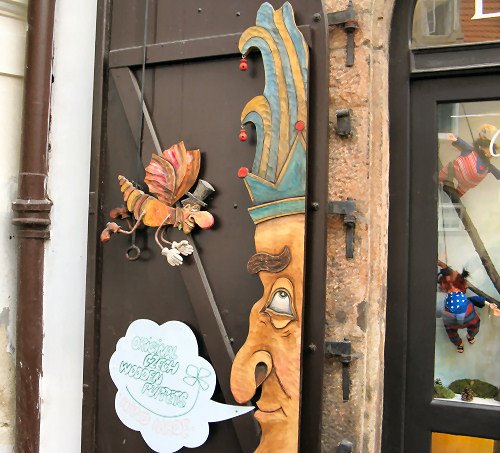
Puppet shop near the Castle! It is indeed a magic town...
Mark and friend, before going for a stroll in the Castle...
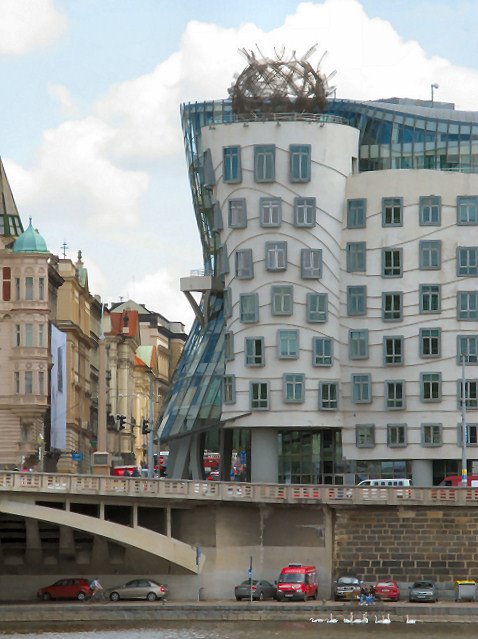
I call it the "Fawlty Towers", although it is a wonderful building with amazing design...
Virgin Mary in a cage...
Not even statues seem to be free of cellulitis these days...
Kafka in Josefov...
Golem's attic in the Altneu synagogue...
Retro Pepsi ad!
Sausages!
A saint in cage. This time in Charles Bridge. Funniest thing was some parents with a little child who insisted in pushing the kid into those bars. Kid was scared to death (even I was), but the oh-so-sensitive parents did not rest until they got a picture of him, crying his lungs out...
Toys, toys and more toys! This is a very cute video! Toy shop in Celetna...

Sunday, May 03, 2009

The Murasaki necklace...

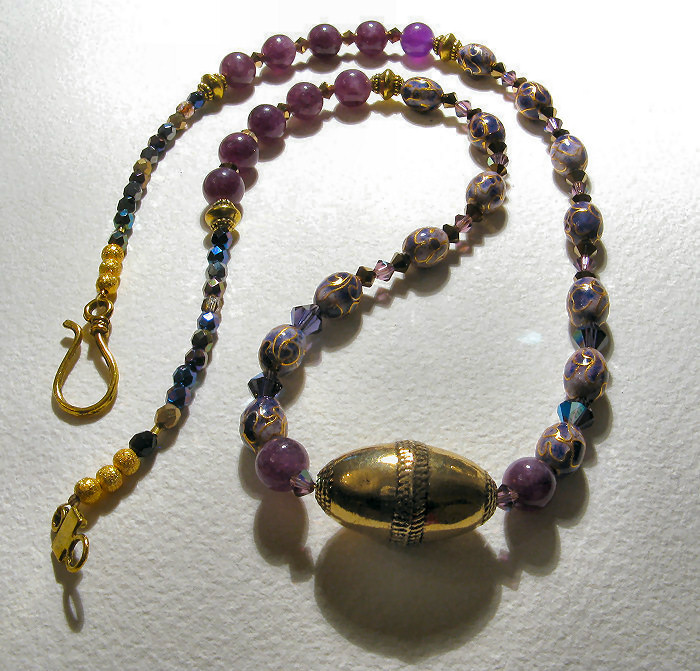
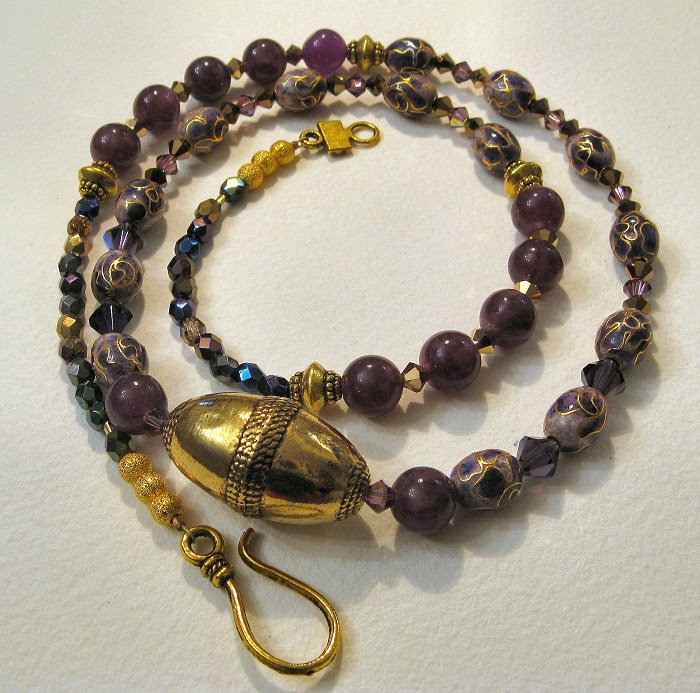
Another Japan-inspired piece. Murasaki is the name of the colour "purple" in Japanese. There are several types of Murasaki shades and tints, based on different pigments and flowers. But the generic term for purple is simply "murasaki":
But Murasaki is also a woman, a writer, Lady Murasaki Shikibu. Her name, or rather pseudonym, refers to the character she has created for her book "Genji Monogatari" ("Tales of Genji"), written some time in the Xth Century Heian period and probably before she joined the imperial court as a maid of honour. She is also contemporary of Lady Shonagon, who was the inspiration for my Hana Kotoba necklace. Two formidable ladies and, indeed, very inspiring.

For this necklace I have used:

- One light brass oval bead as the focal point;
- Several dark purple cloisonnée beads with gold wire;
- Several purple round jade beads;
- Czech fire polished small "heavy metal" beads;
- Antique gold plated Tibetan spacers,
- Stardust small round spacers;
- Several Swarovski bicones in shades of purple and gold, and in different sizes;
- Antique gold plated Tibetan hook clasp.

Details next...


A close-up of the Tibetan antiqued gold clasp and stardust beads. On the second picture, we can see the Czech fire faceted beads in those lovely "heavy metal" shades, along with the Chinese deep purple cloisonée beads and some Swarovski elements. The 3rd picture is pretty much the same, under a dimmed light.


More details of the cloisonnée beads on the 1st picture, and also the jade beads, some Swarovski bicones and Tibetan lantern spacers. I decided to show the other picture because I love the light reflections forming little stars on the faceted Czech fire beads!


Close-up of the jade beads and another shot of the cloisonnées. The Swarovski bicones are shown in full force, very shiny and with a lovely AB2X coating. Please don't forget to click on the images to see it magnified though!


Now, on the 1st picture another close-up of the purple jade beads, but also the Swarovski Golden Aurum bicones in detail. This effect is nowadays a bit hard to find, but I managed to procure some for my beading needs! The second picture is just a funny one. If you click on it, you will clearly see my camera reflected in the bicone, and you can even read the word "LENS" on it, like the bicone has been "printed"! I liked that!

Thursday, April 30, 2009

The Benifuji necklace...

This latest necklace is all about colour experimentation. This week I (re)started to study a bit of Japanese through colours. I mean, Japanese names of traditional colours: colours of nature, different flower shades, leaves, stones, and colours for most aspects of life.

Benifuji is a pale wisteria purple. The name means "crimson wisteria", but may also refer to the wonderful sight of Mount Fuji at sunset. As a colour, it is pale purple, with red/pink undertones. A "warmer" shade of purple, rather than than the usual cooler, bluish tinges that we associate to the colour.

You may visit the NHK blog, which was also an inspiration for this piece. On this blog - exclusively dedicated to Mount Fuji - you will see different views of Fuji Sama at different times of the year by wonderful photographers. A gem of a blog, really, and more than worth a visit.

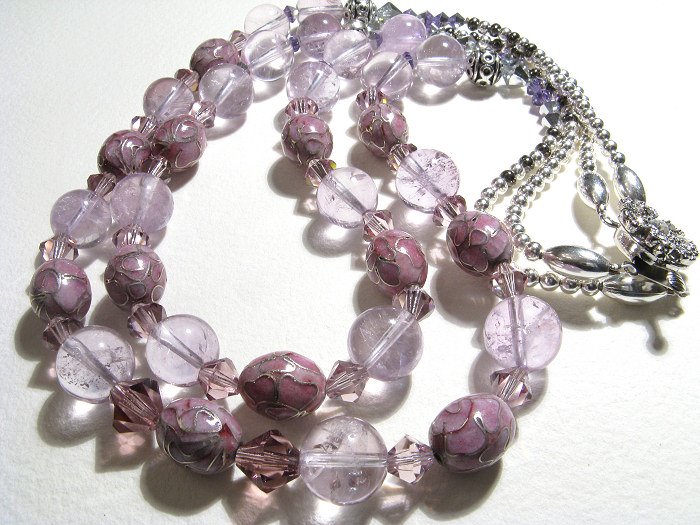
As a flower, the wisteria (fuji) looks like a flowy cascade of purple petals (look at it here), and I tried to portray that using two strands of crystals, amethysts and Chinese cloisonnée beads. Here is the result:


The materials are:

- Several Chinese cloisonnée oval beads in rosy lilac, light purple with silver threads;
- Several medium light Brazilian amethyst beads;
- Swarovski bicones in different sheades of purple and various sizes and effects;
- Tiny silver-plated and blackened silver ball spacers;
- Two silver-plated rice-shaped beads and four Tibetan silver round spacers;
- One double-strand Swarovski clasp with clear crystal embedded.

Some details next...


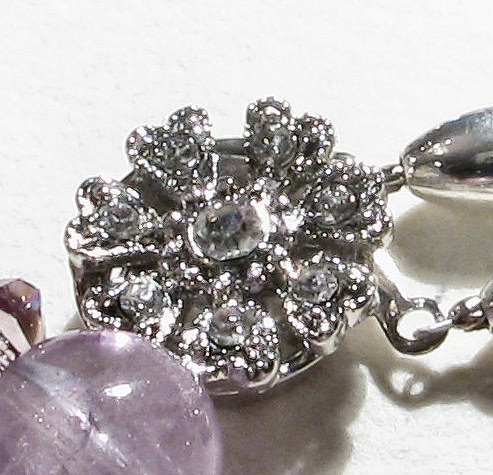
Close-up of the silver-plated Swarovski clasp, clipping style, and also the lovely Brazilian amethyst beads. These are quite unusual, due to their light, pale tint and exceptional transparency. In Japanese, amethysts are very appropriately called "murasakizuishou" (from Murasaki = Purple and Suishou = Crystal, thus "Purple Crystal").


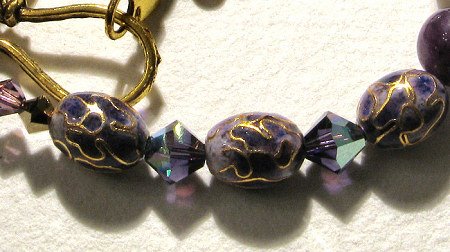
A detail of the smooth Chinese cloisonnée beads with silver thread and some of the Swarovski lilac bicones I used between beads. On the 2nd picture, more Swarovski bicones in other violet colours and effects, along with the silver-plated balls and Tibetan spacers used.
My only complaint about working with this kind of cloisonnée beads is that they are hollow, not drilled like a regular solid bead. So, being hollow makes it harder to string it, for sometimes the wire gets "lost" inside the bead and it takes some time for me to find the way out! I may take from 2 seconds to 5 minutes to string one single bead like that! I love cloisonnée, but dread them at the same time.


Sunday, April 12, 2009

The Tanabata necklace...

I made another necklace today. The idea for it came from the Japanese Star festival, celebrated around July 7th and derived from the Chinese festival called Qi Xi - or "the night of sevens".

The idea of a Tanabata necklace came from a lovely Swarovski teardrop faceted bead I had. Unfortunately, I only had one, then I had to wait to buy the 2nd bead, just like the legend behind the festival, which celebrates the meeting of two celestial lovers, Orihime and Hikoboshi, namely the stars Vega and Altair, respectively. These star-doomed lovers are allowed to meet only on the 7th evening of the 7th month, which very roughly would correspond to the 7th of July, always bearing in mind the date varies due to the Japanese calendar being lunisolar. So, it may happen some time between July and August of our Gregorian calendar.

Tanabata is a time for encounters, and wishes and vows to be written and hung onto bamboo plants or set afloat in the river, and even burnt on festive fires the night of the festival or the day after. It's lights, and that's why I have selected only Swarovski crystals that somehow resemble a night, starry sky on Summer time.

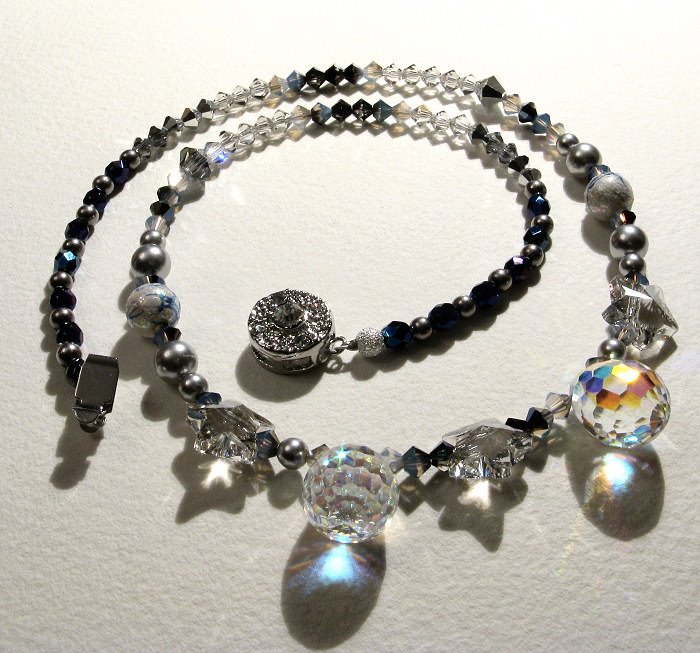
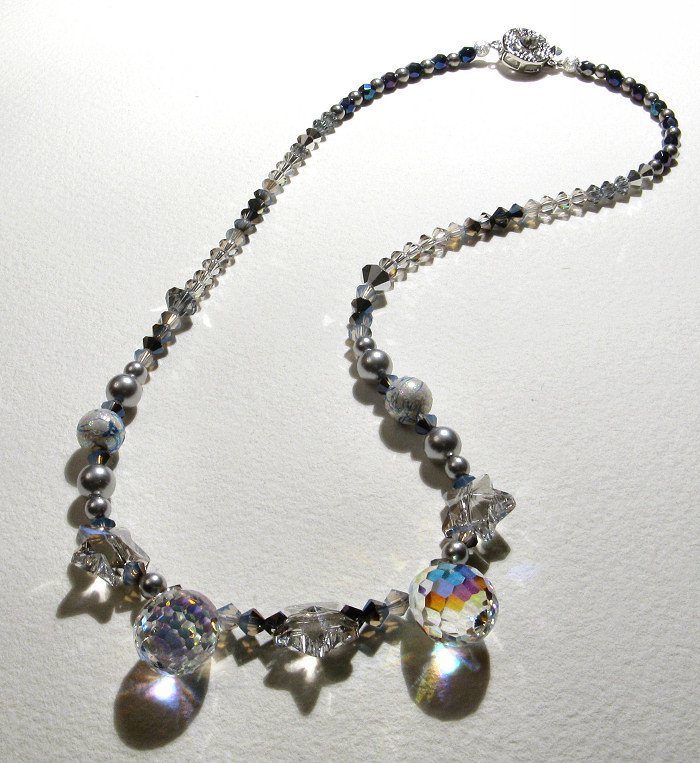
Here is my own view of Tanabata, a portable "festival" to be worn around your neck:


I have used:

- Two Swarovski 6002 disco ball faceted beads representing the two lovers Orihime and Hikoboshi, in clear AB coating;
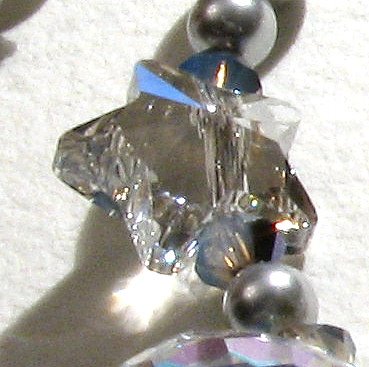
- Three Swarovski star beads in Crystal Silver Shade, representing the Milky Way, or the stars making their way between the lovers;
- Several Swarovski bicones in five to six different shades of silver and blues;
- Ten Swarovski crystal pearls in light grey and different sizes;
- Two large bicones in metallic silver;
- Two medium sized vintage Japanese pearls in white and blue veins;
- Small vintage antique silver round spacers;
- Small Czech Fire faceted beads in shades of blue/green;
- Stardust silver spacers near the clasp;
- One silver-plated Swarovski clasp with embedded strass flatbacks.

Some details as follows...


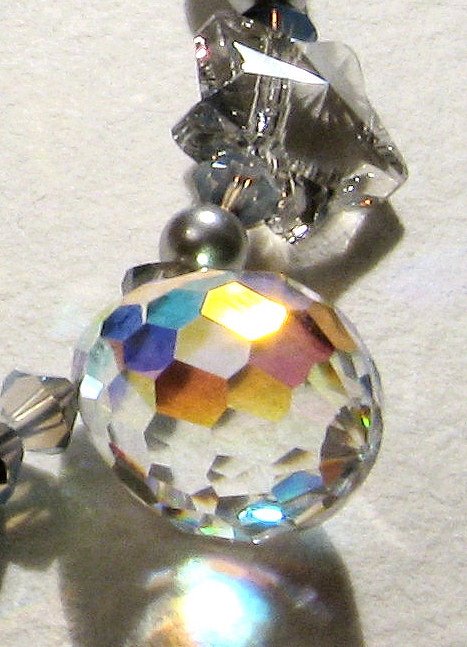
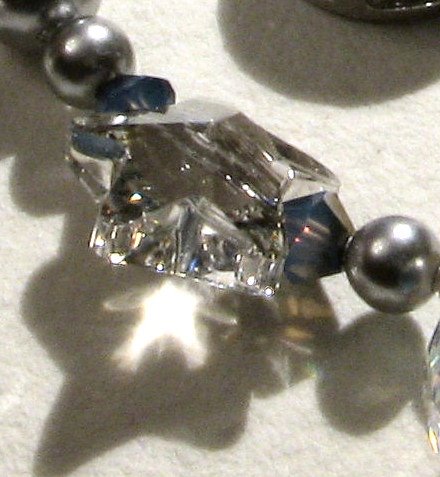
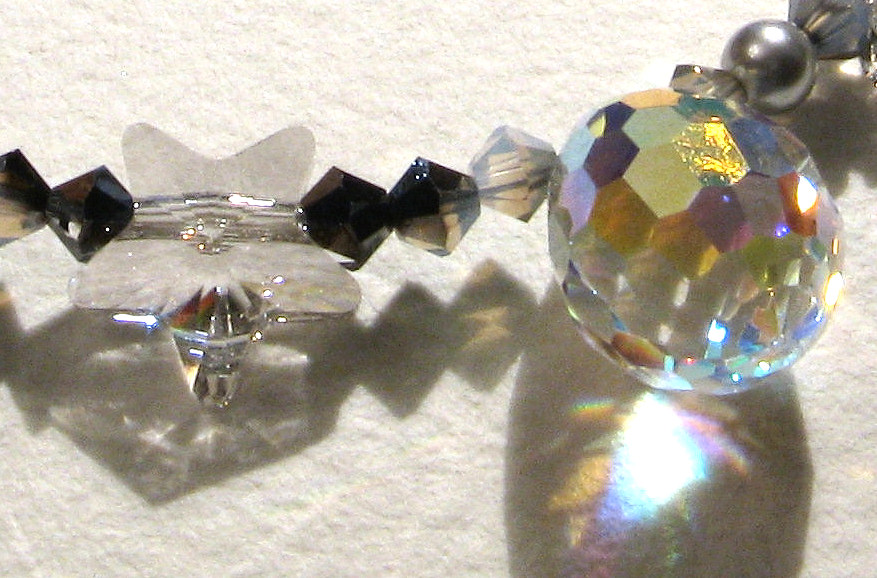
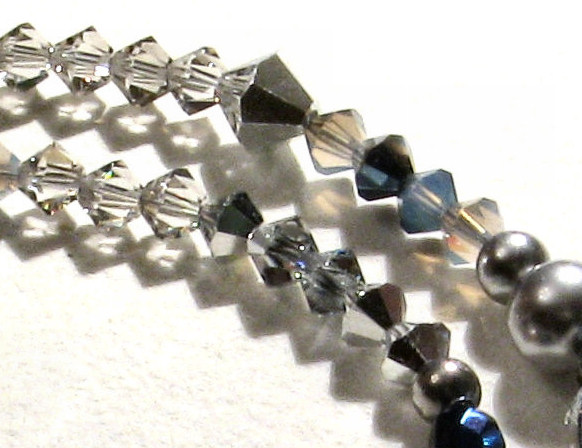
Above, details of the two Swarovski focal beads 6002, representing Orihime and Hikoboshi, with a lovely faceted cut with AB coating. Some of the bicones, pearls and Swarovski stars can also be seen. The 6002 beads are only 15mm long, thus quite small. The necklace as a result is very delicate and short, and no gemstones were used this time.


Some details of the Swarovski crystal silver shade stars, and also the bicones and pearls.


A detail of the Swarovski clasp with embedded rhinestones and more of the 6002 beads, with their wonderful AB effect and impeccable cut.


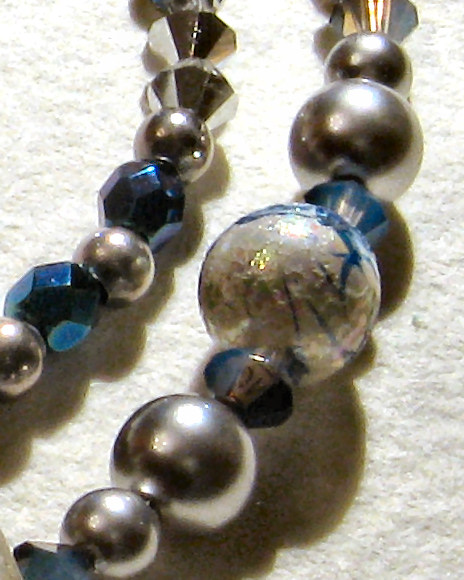
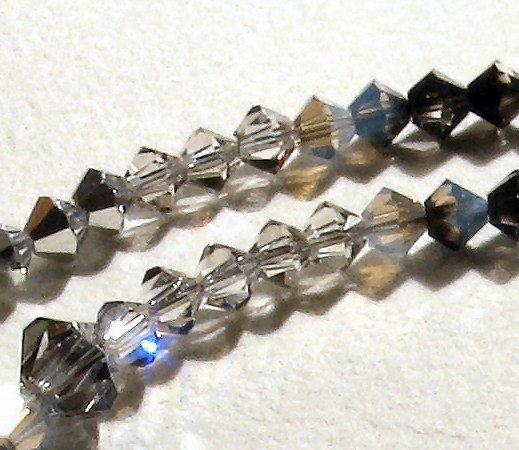
On the 1st picture a detail of one of the vintage Japanese faux pearls in shades of white with blue veins, as well as the Swarovski pearls, some bicones and those small faceted Czech Fire beads. The remaining pictures show close-ups of the bicones in two different sizes and diverse shades of blue, silver and white. I tried to emulate a fading effect with the colours here, that is why I had to use 4 or 5 different shades and effects.

The bamboo leaves rustle, rustle,
shaking away in the eaves.
The stars go twinkle, twinkle;

Gold and silver grains of sand...
(traditional Tanabata song)